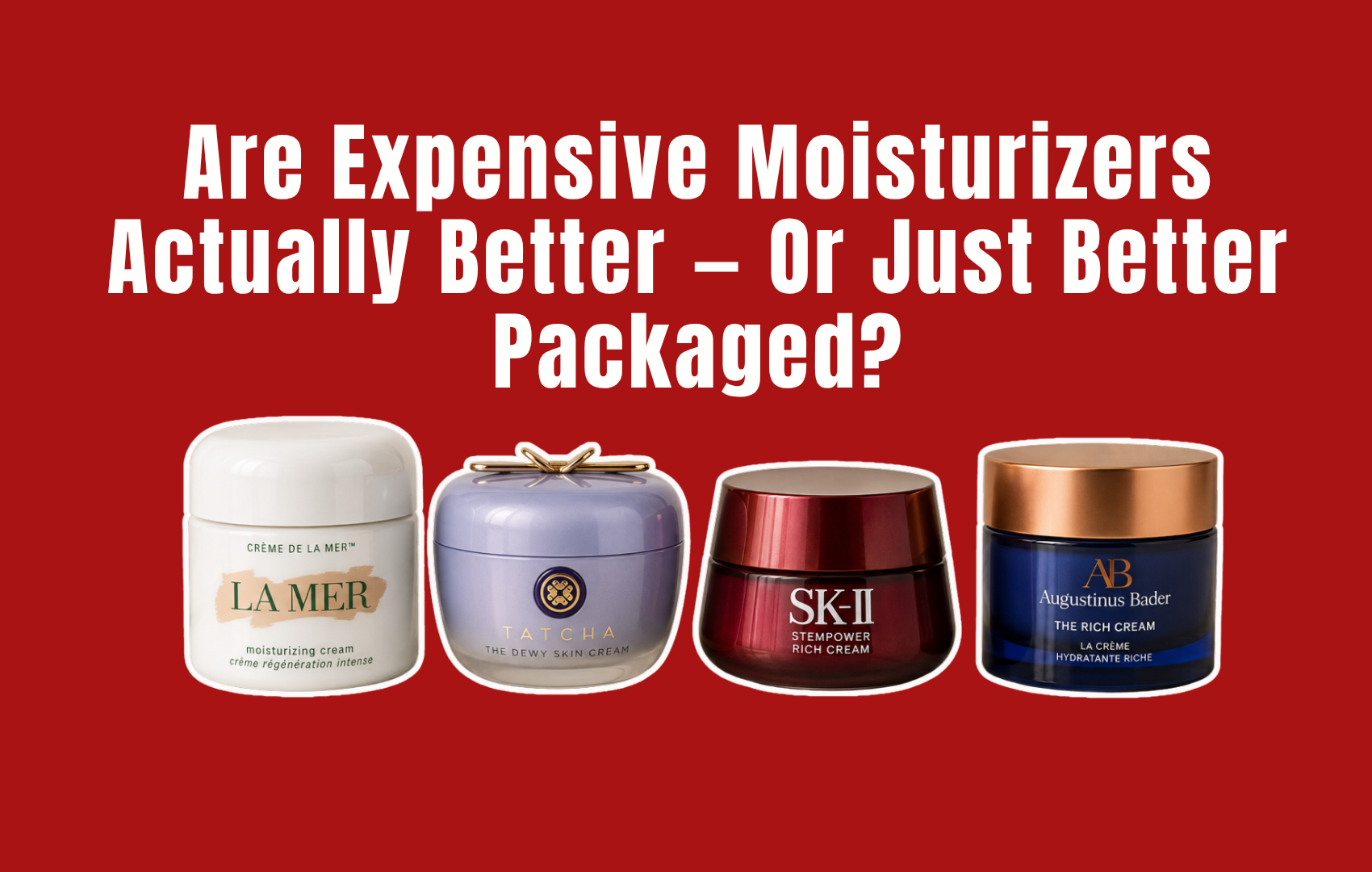
There is a jar of La Mer Crème de la Mer sitting on a lot of bathroom shelves right now. It costs $365 for 60ml. The women who own it — and it is mostly women — will tell you it transformed their skin, that nothing else compares, that it is worth every single dollar. Some of them genuinely believe this. Some of them need to believe it, because the alternative is that they spent $365 on moisturizer and got the same result they would have gotten from a $18 tub of CeraVe.
I spent three months testing four of the most expensive, most-recommended moisturizers on the market against their drugstore equivalents. I read every ingredient list. I tracked my skin. And I came to a conclusion that the luxury beauty industry would very much prefer I keep to myself.
La Mer Crème de la Mer
Verdict: The Most Expensive Story in SkincareLet's start with the mythology. La Mer was created by aerospace physicist Max Huber, who allegedly developed the formula over 12 years to heal his own skin after a laboratory accident. The story is compelling. It is also, at this point, a marketing asset that the brand has been trading on for decades.
The hero ingredient is "Miracle Broth" — a fermented blend of sea kelp and other ingredients that La Mer has never fully disclosed. The brand claims the fermentation process unlocks unique bioactive compounds. What they cannot claim, because no independent research supports it, is that Miracle Broth does anything that other well-formulated moisturizing ingredients don't.
The actual ingredient list reads like a rich emollient moisturizer: mineral oil, petrolatum, glycerin, seaweed extract, various emollients and thickeners. These are good ingredients. Mineral oil and petrolatum are among the most effective occlusive moisturizers available — they lock in hydration exceptionally well. But they are also the primary ingredients in Vaseline, which costs about $4.
My skin felt soft and hydrated using La Mer. It also felt soft and hydrated using CeraVe. The La Mer experience is more luxurious — the texture is richer, the scent is subtle and pleasant, the jar feels substantial in your hand. That sensory experience is real and it has value. But it is not $347 worth of value over a drugstore alternative.
What you're actually paying for: Brand heritage, proprietary mystique, beautiful packaging, and the social signal of owning it. The moisturizing performance is not meaningfully different from products at a fraction of the price.
Tatcha The Dewy Skin Cream
Verdict: Good Formula, Inflated PriceTatcha is more honest than La Mer in one important way: the ingredients it markets are real and present in the formula. Hyaluronic acid, squalane, and niacinamide are all legitimate, well-researched skincare actives. The Japanese purple rice extract is a nice antioxidant addition. This is a genuinely well-formulated moisturizer.
The problem is the price. At $72 for 50ml, you are paying a significant premium for ingredients that are available in far cheaper formulations. The Inkey List Hyaluronic Acid Moisturizer contains the same core actives for $15. Neutrogena Hydro Boost — which has been around for years and has a strong evidence base — costs about $20 and delivers comparable hydration results.
What Tatcha sells exceptionally well is the aesthetic of Japanese skincare ritual. The packaging is beautiful. The brand story — rooted in geisha beauty traditions — is carefully constructed and genuinely appealing. And there is nothing wrong with buying into a ritual you enjoy. But the ritual is what costs $72. The formula is worth maybe $25.
I used The Dewy Skin Cream for four weeks and my skin looked plump and hydrated. I then switched to Neutrogena Hydro Boost for four weeks. My skin looked plump and hydrated. The Tatcha felt more indulgent. It did not perform better.
What you're actually paying for: A legitimately good formula wrapped in a brand identity that costs more to maintain than the ingredients inside the jar.
SK-II Stempower Cream
Verdict: Pitera Is Real — The "Stem Cell" Language Is NotSK-II deserves credit for one thing: Pitera, their proprietary yeast ferment filtrate, has more independent research behind it than almost any other luxury skincare ingredient. It contains vitamins, amino acids, minerals, and organic acids that genuinely support skin renewal. It is not pseudoscience. There is a reason SK-II built an entire brand around it.
What is pseudoscience — or at minimum, deeply misleading — is the "stem cell technology" language that appears in the Stempower line. "Stem cell" in skincare marketing almost never means what consumers think it means. It typically refers to plant stem cell extracts, which are antioxidants. They do not interact with your skin's stem cells. They cannot "activate" cellular renewal in the way the marketing implies. The FDA does not recognize topical stem cell claims, and for good reason.
The base formula is rich and effective. My skin felt firmer after consistent use — but "firmer" after applying a rich moisturizer is largely the result of improved hydration, not cellular regeneration. Any well-formulated cream with good occlusives will produce that effect temporarily.
At $220, you are paying for Pitera — which is legitimate — and for stem cell language that is not. The ratio of real science to marketing fiction in this product is better than most luxury creams, but it is still not $220 worth of better.
What you're actually paying for: One genuinely researched proprietary ingredient, surrounded by standard moisturizing actives, wrapped in language designed to make you feel like you're buying pharmaceutical-grade skincare.
Augustinus Bader The Rich Cream
Verdict: The Most Sophisticated Marketing in the CategoryAugustinus Bader is the most interesting case study in this group because the founder is a real scientist — a professor of cell biology at the University of Leipzig who developed burn treatment technology. The TFC8® complex (Trigger Factor Complex) is a proprietary blend of amino acids, vitamins, and synthesized molecules that the brand claims supports the skin's natural renewal process.
The science sounds credible because it comes from a credible source. And that credibility is exactly what justifies the $295 price tag in the consumer's mind. But here's what the brand does not prominently advertise: the clinical studies supporting TFC8® were conducted by Augustinus Bader's own team, on small sample sizes, and have not been independently replicated in peer-reviewed journals. The professor's burn treatment research is real and impressive. Whether TFC8® in a face cream delivers meaningful skin renewal is a different, much less settled question.
I used The Rich Cream for five weeks. My skin was well-hydrated, comfortable, and looked healthy. It is a genuinely pleasant product with a texture that feels considered and high-quality. But I cannot point to a single result I experienced that I couldn't attribute to simply using a rich, well-formulated moisturizer consistently — which you can do for $20.
What you're actually paying for: A scientist's name, a proprietary complex with limited independent validation, and the most convincing origin story in luxury skincare. It is very good marketing dressed in a lab coat.
So What Does Price Actually Buy You?
After three months and four products, the honest answer is: not much, in terms of skin results. What price buys you in moisturizer is sensory experience, brand story, packaging, and the psychological effect of feeling like you're doing something special for your skin. Those things have real value to real people. They are just not skincare value.
The core job of a moisturizer is to hydrate and protect the skin barrier. That job requires humectants (like hyaluronic acid and glycerin), emollients (like squalane and fatty acids), and occlusives (like petrolatum and mineral oil). All of those ingredients are available in drugstore products for under $25. The skin does not know what the jar cost.
| Product | Price / 50ml | Key Marketing Claim | What the Science Actually Supports |
|---|---|---|---|
| La Mer Crème de la Mer | $365 | Miracle Broth™ heals and transforms | Rich occlusive moisturizer. No independent evidence for "transformation." |
| Tatcha The Dewy Skin Cream | $72 | Japanese beauty secrets, plumping botanicals | Good formula with real actives. Available cheaper elsewhere. |
| SK-II Stempower Cream | $220 | Stem cell technology activates renewal | Pitera is legitimate. "Stem cell" language is misleading. |
| Augustinus Bader The Rich Cream | $295 | TFC8® triggers skin's natural renewal | Proprietary complex, brand-funded studies, no independent replication. |
| CeraVe Moisturizing Cream | ~$18 | Restores skin barrier with ceramides | Ceramides, hyaluronic acid, niacinamide — all independently validated. |
The one product I'd actually defend spending more on is Tatcha — not because it outperforms cheaper alternatives, but because the formula is genuinely good and the price, while inflated, is at least in the same universe as what you're getting. La Mer at $365 is the hardest to justify on any ingredient basis. You are paying almost entirely for the myth.
None of this means you should feel bad for owning any of these products. Skincare is personal, ritual matters, and if a $295 cream makes you feel good about your skin every morning, that psychological benefit is real. Just go in knowing what you're actually buying — because the brands are counting on you not to look too closely.